
AUHEGN Tank Top for Women Summer Sleeveless Scoop Neck Ribbed Workout Tank Tops Slim Fitted Basi
$9.99
View on Amazon →
Published 16 September 2026 · updated 2026-09-16 · by FashionBookings
Swap one accessory and a basic outfit reads as something considered. Accessorising basics — the belts, bags, scarves and jewellery you reach for on autopilot — are the fastest route to multiplying what your wardrobe already does without spending on more clothes.
Most wardrobe problems are actually accessory problems. The outfit that feels flat is often the outfit with the wrong belt, a bag that clashes, or no defined focal point. Getting the fundamentals right fixes this at a fraction of the cost of new clothing.
Not every accessory qualifies as a basic. A basic is a piece that works across multiple outfits, multiple seasons and multiple dress codes without requiring conscious effort. That narrows the category considerably.
The standard edit includes:
None of these are statement pieces. Their job is to anchor any outfit and create the impression of a coherent, considered style — not to shout.
Clothing is the canvas; accessories are the editing. A plain white shirt styled with a structured belt, a single chain and a leather-look tote reads entirely differently from the same shirt with none of those additions — and the difference costs far less than a new top.
The reason accessories punch above their weight is proportion and contrast. A belt at the waist creates a visual break that defines shape. A necklace draws the eye upward. A bag anchors the lower half of an outfit. Each piece is doing quiet structural work, and its absence is more visible than most people realise until they try removing it.
The most common mistake with jewellery is mixing metal tones inconsistently and then adding too many pieces. The result looks cluttered rather than layered.
A workable approach: choose one metal family for the day — gold tones, silver tones or rose gold — and build within it. If you wear hoops, skip the statement necklace. If you layer two necklaces, keep the earrings small.
When layering necklaces, the gap between lengths matters more than the number of pieces. A choker-length piece (around 35–40 cm) paired with a pendant at 45–50 cm creates visible separation. A third layer at 55–60 cm works if the first two are fine-weight chains — heavier chains at multiple lengths reads as tangled rather than styled.
Adjustable chains that run from around 40 cm to 50 cm give you two wearable lengths from a single piece. Look for a sliding clasp or a multi-hole extender — useful when necklines change between summer tops and winter knits.
Lightweight earrings are worth prioritising over heavy statement drops for everyday wear. Over the course of a long day, heavy earrings stretch the lobe and become uncomfortable before the afternoon is out. For hoops, a thinner wire gauge or a hollow construction gives visual impact without the weight. Check the product description for the gauge measurement — a lower gauge number means a thicker, heavier wire.
A belt does two jobs: it defines the waist, and it breaks a monochrome outfit at a point that flatters most body shapes. Both jobs are invisible when the belt is right, and glaring when the width, material or colour is wrong relative to the rest of the outfit.
For everyday wear, look for belts with a smooth full-grain leather or a quality bonded construction. Budget versions often use split leather or thin PU that cracks at the holes within months. Run your finger along the back of the belt: full-grain leather will feel consistent throughout; split leather and PU usually have a fabric or mesh backing that becomes obvious at the edges.
The buckle matters too. A simple frame in brushed nickel, antique brass or stainless steel is more durable than plated metal, which wears fastest at the prong contact point — the part under the most daily friction.
Thin plating on belt buckles wears through at the prong contact point — often within three to six months of daily use — leaving a patchy, obviously worn look that dates the belt faster than the leather itself. Look for a buckle described as solid brass, stainless steel or solid alloy rather than just "gold-tone" or "silver-tone," which usually means plating over a base metal.
A bag is the most functional accessory in the edit, and it does more visual work than almost anything else because it travels with every outfit throughout the day.
A structured bag holds its shape when set down empty. An unstructured bag collapses. For a day bag that works across smart-casual and casual settings, light structure — a bag that keeps its form but is not rigid — is usually the most versatile choice. Look for a base wide enough to sit flat (at least 10 cm across the base) and handles long enough to sit over a coat shoulder, roughly 55–65 cm drop.
A detachable crossbody strap is worth seeking out. It changes how formal the bag reads — shoulder carry with handles reads smarter, crossbody reads more casual — effectively giving you two configurations from one piece.
| Feature | Look for | Avoid |
|---|---|---|
| Exterior material | Smooth PU, grain leather or canvas | Glossy patent on daily bags (shows every scratch) |
| Hardware colour | Matches your jewellery metal tone | Mixed metals within one bag |
| Closure | Magnetic snap or zip | Press stud only (wears the material around it over time) |
| Strap drop | 55–65 cm for shoulder carry | Fixed handles with no adjustable strap option |
| Base construction | Stiff base panel or corner feet | No base reinforcement on a bag intended for daily use |
Check the seam at the base corners on a bag you are considering — this is where cheap lining fails first, and a failed lining makes the bag impractical faster than any external wear.
A scarf is the accessory most people already own and least people use consistently. The barrier is usually knowing the ways to wear it, not the cost of buying one.
A 90 cm square opens the most options: tied at the neck, worn as a headband, looped through a bag handle, or worn open over the shoulders as a light layer. A rectangular pashmina-style wrap gives more coverage and works as an extra layer on cool evenings or in air-conditioned spaces during summer.
For material: a modal or modal-blend scarf is warmer, softer and lighter than viscose, and holds a knot far better than pure satin-weave polyester, which slips loose within an hour. Check the label. If the description only says "polyester satin" or "silky feel," manage your expectations accordingly.
Neutral scarves — cream, camel, charcoal, navy — do more work across more outfits than a bold print. One patterned option, a classic check or a small geometric, adds variety without clashing. Most wardrobes need one neutral and one patterned; anything beyond that moves out of basics territory into a styling collection.
Sunglasses are the accessory that carries a genuine health function alongside the style one. Lenses without real UV400 certification do not block UV radiation despite tinting the light — the pupil dilates in the dimmed light and actually admits more UV than if you wore nothing at all.
Look for "UV400" or "100% UVA/UVB protection" in the product description, not just "UV protection," which is a vague claim. UV400 means the lens blocks wavelengths up to 400 nanometres, covering both UVA and UVB. Sunglasses sold legally in the UK must carry either a CE mark or the UKCA mark — the latter replaced CE for UK market goods after post-Brexit standards came into effect — confirming they meet the basic optical and safety standard.
Rather than a simplified face-shape guide, the more useful check is proportion. Frames should not extend wider than the widest point of your face at rest, and the lens depth should cover the eye socket without sitting on the cheekbone when you smile. Those two checks rule out the most common misfits regardless of face shape.
A functional basics edit does not need many pieces. A working set for most wardrobes:
That is six items covering the majority of daily styling needs. The power is not in owning fewer things, but in owning things that work together — the same metal tone across jewellery and bag hardware, the belt leather echoing the bag material, the scarf neutral coordinating with the belt colour.
Cohesion at the accessory level is what makes a simple outfit look considered rather than thrown together. It comes from choosing with intent, not from spending more.


Check the base metal and plating type, not just the price. Vermeil — gold plating over sterling silver — lasts far longer than gold-plated brass because silver doesn't corrode through to the surface the same way. For earrings, the post material matters more than the decorative finish: surgical steel, titanium and sterling silver posts are hypoallergenic and resist tarnish at the skin contact point. If the listing doesn't name the base metal, treat that as a warning sign.
Tan or camel sits between the two most common wardrobe neutrals — black and navy — and coordinates with both without effort. Black is the safe choice but can read heavy against lighter outfits. Tan works across denim, grey, cream and most prints without clashing. If your wardrobe leans predominantly dark, black is the practical pick. If it is more varied in colour, tan earns its place faster across more combinations.
For genuine leather, a light application of leather conditioner every few months prevents the surface drying and cracking — flex stress concentrates at the holes, so that area benefits most. Avoid storing belts coiled tightly or in direct sunlight for extended periods. For PU and bonded leather, conditioning does not penetrate; the key is avoiding sharp bends and keeping the surface clean, as splits typically begin at a crease point rather than from general surface wear.
Yes, with intention rather than accident. The approach that works best is anchoring the look in one metal — gold hoops, for example — and allowing a single contrasting piece such as a watch or stacked ring in silver. Mixing becomes harder when both metals appear at the same scale and in the same zone, for instance two necklaces of equal weight, one in each metal. The more deliberate the combination reads, the more it lands as a style choice rather than an oversight.
As an Amazon Associate we earn from qualifying purchases. Prices and availability are accurate as of the date shown and are subject to change — the price on Amazon at checkout is the one that applies.
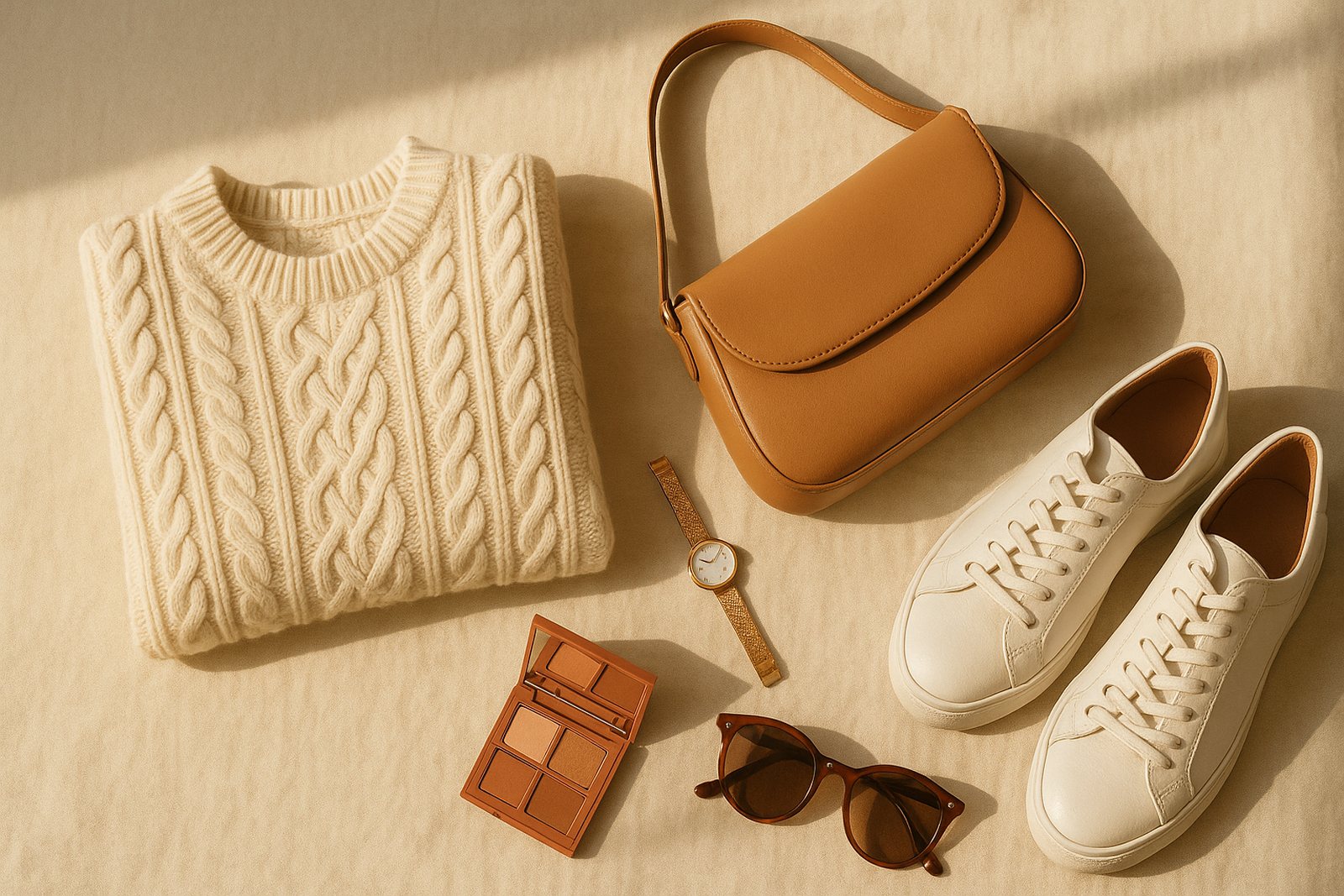
Learn how to accessorise a plain outfit: the one-metal rule, two leather tones maximum, and the three accessories worth buying fir
Women's US fashion worth buying this month: knit tops and sweaters from £9.99–£31.69, rated 4.1–4.6 stars, plus how to spot fake d
Find the best women's activewear leggings sets for under $40 — what to check for fabric quality, support, fit, and value before yo